
2026 marks 60 years since the founding of the Process Church of the Final Judgment, offering an inspiring opportunity to revisit the origins, evolution, and legacy of one of the 1960s’ most enigmatic religious movements. This exploration traces the founding moment, the foundational ideas that shaped the group, and the cultural impact that followed.
The Process Church of the Final Judgment was a British religious organization founded in 1966. Its founding period, rooted in a break from Scientology, quickly gave way to a distinctive theology and a countercultural presence that spanned the United Kingdom and the United States during the late 1960s and early 1970s.
Process Church Foundation
The foundation of the Process Church of the Final Judgment remains one of the most unusual chapters in the history of new religious movements. The group emerged from the experiences of its core leaders, Robert de Grimston (born Robert Moore) and Mary Ann MacLean, who met through their involvement with Scientology in London in the early 1960s. Both participated in Scientology’s advanced auditing programs, and their work together shaped the psychological and theological framework that later defined the Process. After leaving Scientology in 1962, the pair began developing a new system centered on intense interpersonal exercises that blended elements of psychoanalysis, spiritual discipline and existential exploration. These early practices laid the foundation for what would become the Process Church.
By 1966, the foundation year formally recognized by most scholars, a growing circle of followers had adopted the group’s evolving worldview. The organization established its headquarters in London and soon created a distinctive public identity reinforced by its black robes, German Shepherd dogs, elaborate symbols and striking publications. Members often lived communally, adopted new names and traveled widely to recruit and engage curious seekers at a time when the counterculture was expanding across the United States and Europe. While its imagery seemed severe to outsiders, internal accounts describe a highly structured organization that emphasized loyalty, shared labor and strict adherence to group teachings.
The Process Church developed a theological system that centered on four archetypal deities: Jehovah, Lucifer, Satan and Christ. Leaders taught that spiritual wholeness required the reconciliation of these forces, which represented authority, creativity, destruction and love. Rather than treat these figures as purely literal beings, the Church often invoked them as psychological or cosmic principles meant to illuminate human nature. This foundational synthesis of Western religious symbolism with quasi-therapeutic insight distinguished the Process from other alternative movements of the period.
The group’s magazine, The Process, became one of the most significant artifacts of the movement. Visually rich and editorially ambitious, it featured contributions from cultural figures ranging from filmmakers to musicians. As a foundation, the publication offered essays, interviews, photography and theological reflections that showcased the Church’s artistic aspirations and countercultural sensibilities. These magazines have since become valuable primary sources for researchers, given their documentation of internal belief systems and their commentary on social and spiritual questions circulating in the late 1960s.
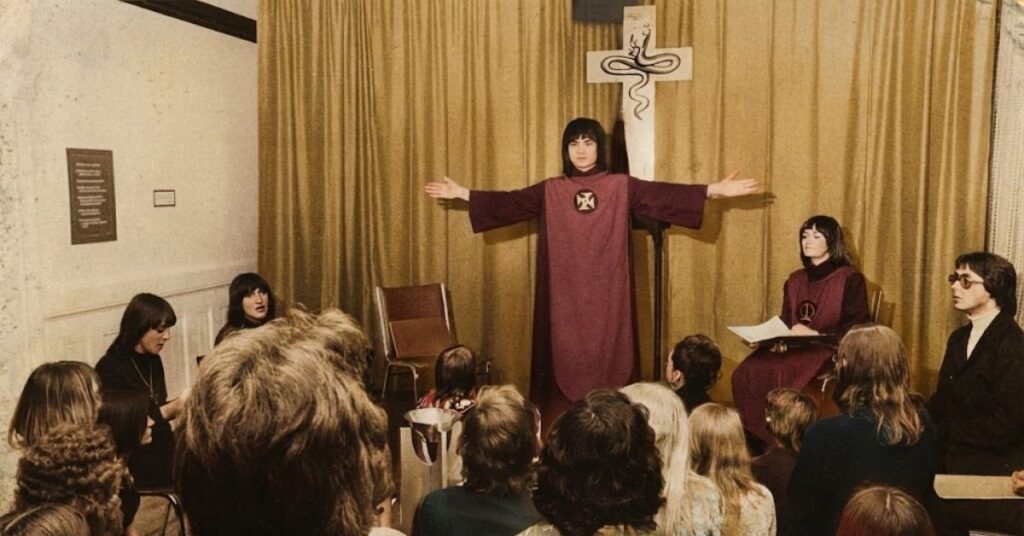
During its expansion in the United States, the Church established centers in cities such as New Orleans, New York, San Francisco and Los Angeles. The San Francisco presence was particularly notable, located in the Haight-Ashbury neighborhood during an era when it served as a gathering place for those exploring new forms of spirituality. The Church also gained attention for its public rituals, small-scale outreach programs and eccentric storefronts designed to intrigue passersby.
The Process Church later became the subject of conspiracy theories involving both Charles Manson and the Son of Sam case. These claims have been widely disputed by scholars, journalists and former members, and no credible evidence has ever substantiated them. Still, the speculation contributed to the group’s notoriety and complicated its public reputation.
By the mid-1970s, the organization entered a period of transition and fragmentation. Many members relocated to Utah, where the group gradually abandoned its apocalyptic framing and shifted its foundation toward animal welfare work. This evolution ultimately led to the formation of what is now the Best Friends Animal Society, one of the largest animal sanctuaries in the United States. Although the modern organization operates without theological content, its roots in the founding era of the Process remain a notable part of its institutional history.
Today, scholars regard the Process Church as a distinctive example of how new religious movements adapt to cultural pressures, external narratives and internal transformations. Its foundatiion continues to draw interest because it illustrates the intersection of belief, identity, counterculture and reinvention over multiple generations.